

In an active shooter event inside a commercial building, the response timeline is brutally short. Studies of past incidents consistently show events that unfold and end in minutes, often within seconds of the first shot. The gap between that first shot and any organized response is the time during which everyone in the building is making decisions without information. Closing that gap is what indoor gunshot detection technology actually does. This article explains how the technology works, what makes SDS by Alarm.com different from acoustic-only alternatives, what's involved in actually deploying it, and how Surety Business has made it viable for small and mid-sized organizations through a self-install service model.
Two Technologies for Indoor Gunshot Detection
Indoor gunshot detection systems split into two technical categories: acoustic-only and dual-modality. Acoustic-only systems use microphones to listen for the impulsive sound of a gunshot. The hardware is cheaper and the detection logic is one-dimensional, which is also the problem. Anything that produces a similar acoustic signature can fool it: a slammed dumpster lid, a heavy dropped object, fireworks, a vehicle backfiring near an open loading dock door. False alerts become a persistent operational issue and erode trust in the system over time, until the alerts get ignored or the system gets disabled.
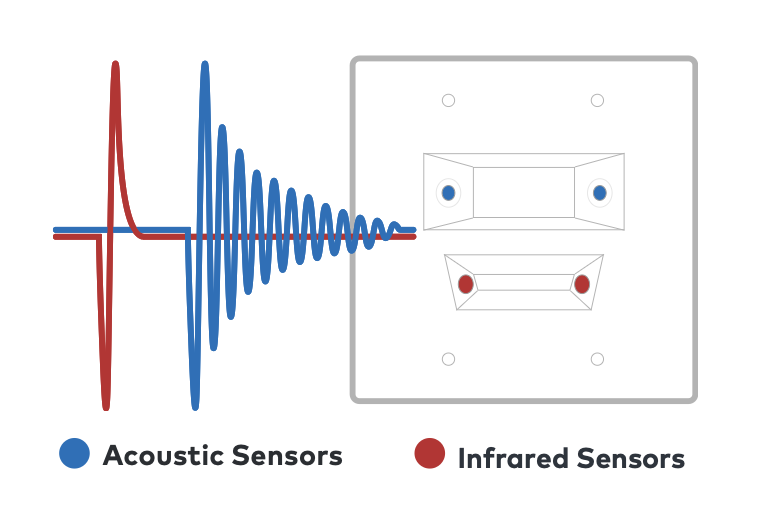
Dual-modality systems pair an acoustic microphone with a passive infrared sensor that detects the brief heat signature of a muzzle flash. Both signals must trigger within a tight time window for the system to declare a confirmed gunshot. A backfire produces sound but no infrared event. A camera flash or stray heat source produces an infrared event but no acoustic event. Only an actual gunshot produces both at once. SDS uses two acoustic microphones and two infrared detectors per sensor (model ADC-SDS2001), and that dual confirmation is what produces the system's published 99.99% accuracy rate, with fewer than one false alert per five million service hours of field deployment.
What 0.5-Second Detection Means
The latency from gunfire to confirmed alert at Alarm.com's cloud is under half a second. That number sounds like a marketing stat until you place it next to a typical 911 timeline: someone in the building has to stop, recognize what they're hearing, find a phone, dial, and articulate what they heard. Even composed witnesses often take 30 seconds or more to do that, and many delay longer because they aren't initially sure the sound was gunfire. SDS removes that delay entirely. Within the same half-second window, push notifications and SMS messages reach designated contacts, Surety's monitoring center is alerted with linked video feeds, and any configured automation rules execute: video recording starts, mass notifications go out, perimeter doors lock, and elevators recall. None of those actions require anyone in the building to take any deliberate step.
A Sensor Built for One Job
Each ADC-SDS2001 indoor sensor houses two acoustic microphones and two infrared detectors behind a flush-mount or surface-mount housing roughly four inches square. A single sensor covers approximately 2,500 square feet of indoor space with omnidirectional detection, and direct line-of-sight to the firearm is not required. A shooter facing away from the sensor or partially obscured by a cubicle wall, retail display, or other interior obstruction can still be detected within range.
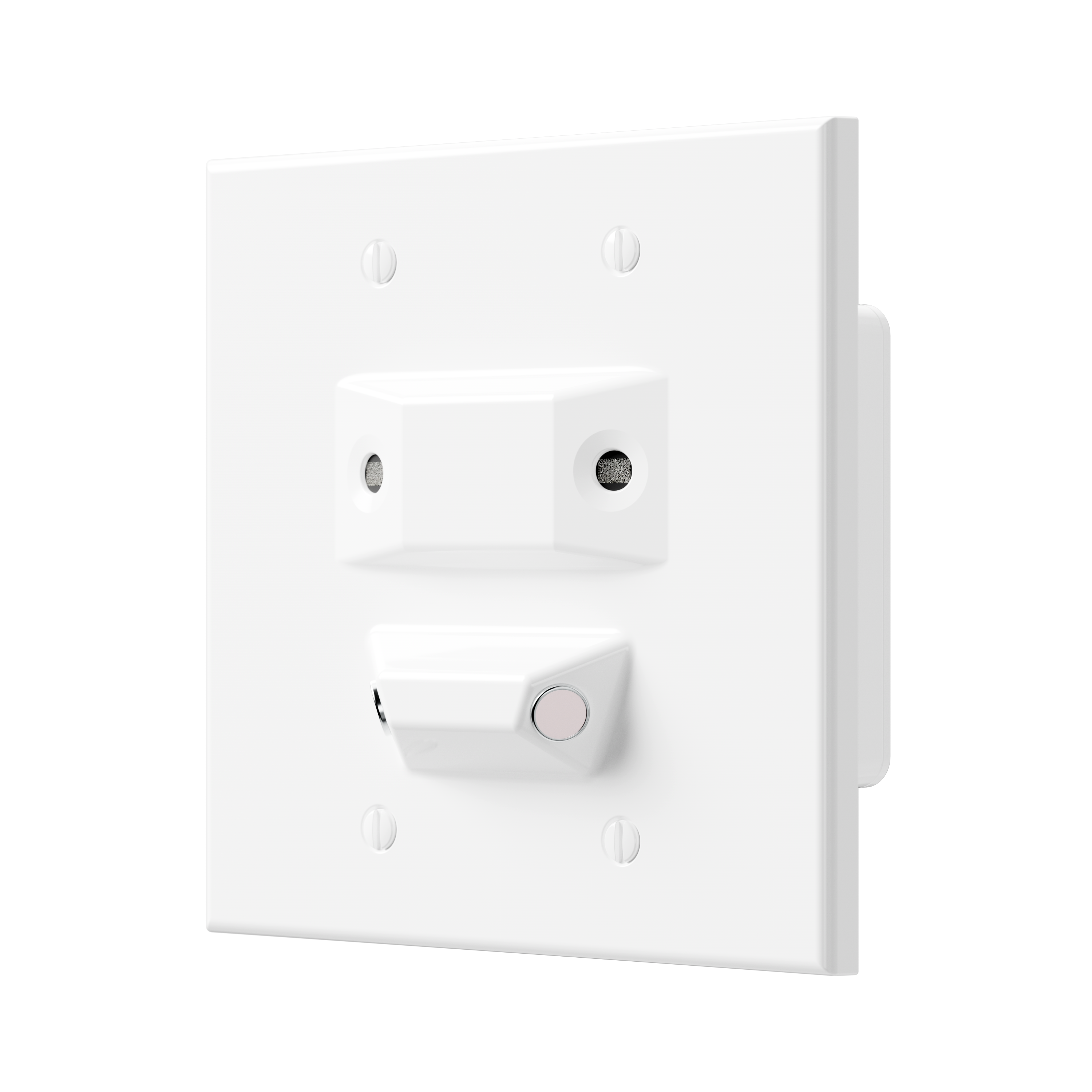
Importantly, the sensor does not record, store, or transmit audio. The acoustic detector is a pattern matcher tuned to the impulse signature of gunfire, not a microphone that captures speech. There is no surveillance capability, and informing employees of that fact is part of any clean rollout. SDS is a detection system, not a listening device, and that distinction matters for both the policy and HR conversations a deployment will inevitably involve.
Sensor Placement and Coverage Planning
Mounting height for an SDS sensor is typically 9 to 12 feet, on a wall or ceiling. The 2,500-square-foot per-sensor coverage figure assumes a typical indoor space and modest overlap when planning multi-sensor layouts. The practical question for most small and mid-sized buildings is not "does this sensor work?" but "where do I put them?"
A small retail floor plan with a 2,000-square-foot sales area, a 600-square-foot stockroom, and a 400-square-foot office space can usually be covered by three sensors: one centered over the sales floor, one in the stockroom, and one in the office area. Hallways count toward sensor coverage zones rather than requiring their own sensors, as long as the hallway falls within the radius of an adjacent space's sensor. Spaces with hard architectural separations like fire doors, structural walls, or floor-to-ceiling partitions should be planned with separate sensors per partitioned area, even when total square footage is below 2,500. The Surety support team can sanity-check a layout based on a floor plan; this is the kind of installation where it pays to plan before drilling holes.
Network and Infrastructure Requirements
Each SDS sensor uses a single Power over Ethernet (PoE) cable that delivers data and power on the same line. That eliminates the need for separate AC outlets at sensor mounting points and consolidates installation to a single trade. Most modern small-business networks already have a PoE-capable switch; deployments without one will need to add a PoE switch or per-sensor PoE injectors, neither of which is expensive. Sensors run on the same internal network as other Alarm.com devices and don't require their own VLAN, though network-segmenting them onto an isolated security VLAN is a reasonable hardening choice for organizations that already segment by function.
A cellular connector provides dual-path communication: the system reaches Alarm.com's cloud over both broadband and cellular simultaneously, so an alert still goes out if the local internet connection is down at the moment of the event. The cellular connector ships with the starter kit.
A Self-Install That Actually Is Self-Installable
The two physical tasks for an SDS install are running an ethernet cable to each sensor location and mounting the sensor to a wall or ceiling at the planned height. Both are within reach of anyone comfortable with basic networking or security-camera work. The sensor's PoE port handles power and data on a single connection, so there is no separate power supply or AC outlet to coordinate at each location. Some jurisdictions require a licensed low-voltage contractor to run ethernet cable in a commercial building, so verify local building codes before starting. After mounting, each sensor is verified using the ADC-SDS1000 handheld tester, which is included in the starter kit and simulates gunshot acoustic and infrared signatures without live fire to confirm detection coverage and alert routing in every zone. Surety support can walk through planning and verification with new installers.
DHS SAFETY Act Certification and the Liability Question
SDS holds the highest level of U.S. Department of Homeland Security SAFETY Act Certification, the federal program that grants liability protections to sellers and users of approved anti-terrorism technologies in connection with events that the Secretary of Homeland Security declares an act of terrorism under the SAFETY Act. The SAFETY Act has two principal tiers, Designation and Certification, with Certification being the higher one and requiring proven real-world performance rather than just laboratory testing. SDS is the only indoor gunshot detection system at the Certification tier.
For a business owner or facility manager, the practical effect is twofold. First, deploying a SAFETY Act Certified system is a documented, named step that goes into the file an insurer or attorney will review after an incident, and it stands as a marker of due diligence regardless of how the event is later classified. Second, if the incident is declared an act of terrorism under the SAFETY Act, the certification extends substantial procedural and substantive liability protections downstream to organizations that have deployed the system in accordance with its design, including a rebuttable government-contractor defense that comparable acoustic-only or non-certified dual-modality systems do not provide.
Coordinated Response Through the Alarm.com Platform
Even as a stand-alone deployment, SDS is fully professionally monitored. A gunshot event reaches Surety's central monitoring station the same moment that the app and SMS alerts go out, and a trained operator dispatches emergency services in response. Stand-alone SDS gives you detection, designated-contact notification, and police dispatch out of the box; an existing alarm panel is not a prerequisite. What an integrated Alarm.com for Business platform adds on top of that is automated, multi-system response. An SDS gunshot event can launch video recording on every camera in the same zone, capturing pre- and post-event clips that the monitoring operator can view alongside the alert before dispatch. It can fire access control rules: lock perimeter doors, restrict elevator floors, release magnetic locks on designated evacuation routes. It can sound intrusion sirens and strobes for building-wide warning. The broader security system integration doesn't impact whether you get a police response; it changes how much else happens in parallel during the seconds before they arrive.
The DIY Model: How Surety Business Changes the Access Equation
SDS hardware is identical regardless of who installs it, but the commercial model around it has historically been dealer-driven: a multi-year service contract, professionally installed sensors, and pricing built around the dealer relationship. That structure works for federal facilities and large enterprises with security-operations teams and capital budgets. It has been an effective barrier to entry for the SMB market that arguably has the most to gain from this technology. Surety Business is the only DIY (self-install) Alarm.com service provider focused exclusively on small and mid-sized businesses, and its month-to-month service model lets organizations buy SDS hardware directly, install it themselves (or with a low-voltage subcontractor for the cabling), and pay only for monitoring on a no-contract basis. The hardware, the platform, and the SAFETY Act Certification are unchanged. Only the commercial wrapper around them is different.
Reading the Total Cost of Ownership
The dual-modality gunshot detection market splits into two pricing structures that look similar on day one and diverge sharply over time. Most dual-modality competitors are sold as ongoing per-sensor subscriptions: a recurring fee per sensor for the entire life of the deployment, often $60 or more per sensor per month. SDS is sold as a one-time hardware purchase with monitoring on top. The five-year math favors purchase-based pricing meaningfully, and the gap widens further over a ten-year horizon because the per-sensor subscription line item never amortizes away. Lower-priced acoustic-only systems carry a lower upfront and ongoing cost than either, but they do so by sacrificing the dual-modality logic that produces the 99.99% accuracy rate, which means they trade dollars for false-alert volume and the operational friction that comes with it. The right financial frame isn't sticker price; it's protection per dollar across the system's deployed life. Run the math out five years and the answer for most organizations is purchase-based dual-modality, which is where SDS sits.
A Common Deployment Scenario
A 10,000-square-foot cannabis dispensary with a customer floor, a back stockroom, and a small office area can typically be fully covered by four sensors: two on the customer floor, one in the stockroom corridor, and one in the office area. The starter kit includes two sensors and covers two of those zones, and two additional sensors round out the deployment. The same plan and the same hardware would protect a similarly sized urgent care clinic, jewelry store, or small house of worship. Larger or more architecturally complex spaces add sensors per partitioned area; smaller single-room locations may run on the starter kit alone.
Funding Paths for Schools, Nonprofits, and Public Facilities
For grant-eligible organizations, federal and state programs can offset some or all of the deployment cost, and the eligibility universe is broader than most operators initially realize. K-12 schools, public and private, are the primary target population for gunshot detection grants, and SDS adds a hardware rebate of approximately 15% for qualifying K-12 institutions on top of any grant award. Nonprofits with 501(c)(3) status can pursue the Nonprofit Security Grant Program administered by FEMA, which has historically funded houses of worship, community centers, and other at-risk nonprofits. The STOP School Violence Program administered by the DOJ Bureau of Justice Assistance funds school-safety technology purchases on a recurring annual cycle. The Preparing for Active Shooter Situations (PASS) grant and various state-level school-safety and active-shooter response grants round out the federal-and-state landscape. Application windows are typically annual and can close quickly once announced, so the right move for any eligible organization is to confirm plan alignment before a grant cycle opens, not after.
Where SDS Fits and Where It Doesn't
The SDS sensors offered by Surety Business are indoor sensors. Outdoor coverage, parking lots, loading bays open to the air, and similar exterior areas are typically handled by camera-based detection or by an outdoor gunshot detection system. SDS recently introduced SDS Perimeter, an outdoor companion to the indoor product, but it is not currently part of the Surety Business lineup. Coverage on the indoor system is per sensor, so larger facilities scale linearly: more square footage means more sensors. The system accelerates response but does not prevent incidents, and it does not replace physical security measures, access control policies, or emergency-response training. The strongest active-threat posture is layered, with video analytics, professionally monitored intrusion and access control, and trained personnel on top of detection. SDS is one layer. It is a very effective layer, but it is a layer.
Frequently Asked Questions
- How does SDS handle multiple gunshots in rapid succession?
The system reports each detected event as it occurs. Rapid follow-up shots produce continuous alerting and event logging rather than a single deduplicated alert, which gives Surety's monitoring operators and law enforcement an accurate picture of the timeline and rate of fire as the incident unfolds. The half-second detection window applies to each event independently.
- What happens if internet and cellular are both unavailable at the moment of an event?
The dual-path communication architecture is designed precisely so that simultaneous broadband and cellular failure is the only scenario in which an alert can fail to reach the cloud. Both paths failing at the same moment is rare in practice. In a deployment where it's a credible concern (severe-weather areas, single-carrier cellular dead zones), the right move is to verify dual-path performance during initial commissioning and to add cellular signal-boosting hardware if needed before relying on the system in production.
- How often should sensors be tested after installation?
The manufacturer recommends testing each sensor with the ADC-SDS1000 handheld tester at least once per year. Some organizations choose semi-annual testing for added confidence, particularly in environments where the cost of a missed event is high relative to a few extra hours of testing labor. The handheld tester is included with the starter kit and is the only piece of equipment needed for routine verification.
- Can SDS be deployed alongside non-Alarm.com cameras or access control?
SDS integrates most cleanly with Alarm.com cameras and access control because it lives natively on the Alarm.com platform. It can run as a stand-alone gunshot detection system in environments with non-Alarm.com infrastructure, but in that configuration the integrated automations (lockdowns, video correlation, single-pane monitoring) are not available the same way. Organizations evaluating mixed-vendor deployments should weigh the integration loss against the cost of moving cameras or access control onto Alarm.com.
- Does deploying SDS lower commercial property or liability insurance premiums?
Insurance treatment of active-threat technology varies across carriers and lines of business. Some commercial carriers explicitly factor documented active-shooter response infrastructure into renewal pricing; others fold it into broader risk-management discounts; some have no formal program but will respond to a documented deployment as a positive variable in underwriting. The right move is to disclose the deployment to your broker or commercial lines agent and ask how the carrier weighs SAFETY Act Certified detection in their renewal model. Insurance treatment is also evolving as carriers update their models, so a "no" today is not necessarily a "no" at the next renewal cycle.
The Bottom Line
Gunshot detection collapses the gap between a shooting incident and the start of a coordinated response. Dual-modality detection eliminates the false-alarm problem that has historically plagued acoustic-only systems, and DHS SAFETY Act Certification gives the strongest available legal and insurance posture for the deployment decision. SDS by Alarm.com is the most proven technology in that category, and Surety Business's self-install, month-to-month model puts it within reach of the small and mid-sized organizations that have most often been priced out of it.
