

A $79 sensor on the floor behind your ice machine is the cheapest insurance a small business can buy, because the average water and freezing damage claim now runs about $34,600 and a sensor is what turns a Monday-morning disaster into a Friday-night phone call. You are not buying flood prevention. You are buying detection time, and detection time is the entire ballgame.
Picture the version without it. A braided supply line behind the ice machine lets go Friday at 11 p.m., twenty minutes after the last person locks up. It runs all weekend. By the time the opener walks in Monday at 6 a.m., water has crossed the kitchen, found the subfloor, wicked eighteen inches up the drywall, and stood in the dry-goods stockroom for two days. The repair is the small part. The four days closed, the discarded inventory, the mold remediation, and the claim on the loss history are the big part.
The same failure, caught in twenty minutes, is a mop and a service call.
What Water Damage Actually Costs a Small Business
Water damage is not a freak event. According to The Hartford's analysis of more than one million small-business property and liability policies, covering claims filed from 2020 through 2024, water and freezing damage is tied for the single most common small-business claim at 20%, alongside burglary and theft (20%) and slip, fall and customer injury (20%). Wind and hail came in at 15% and fire at 10%. Measured as a share of all claims across that same 2020 to 2024 window, it works out to roughly 22%.
The frequency is also getting worse. When The Hartford ran the same analysis a decade earlier on 2010 to 2014 claims, water and freezing damage represented 15% of claims. It is 20% now.
Here is the part that should open your eyes. Water and freezing damage is also the fourth most expensive claim type on the list, averaging about $34,600, behind fire (about $80,000), vehicle accidents (about $50,000), and slip and fall (about $45,000). Most business risks are either frequent or expensive. Water is both. That intersection is unusual, and it is why leak detection returns more per dollar than almost anything else you can bolt onto a building.
The Hartford's figure combines water and freezing damage together across every kind of small-business policy, so your own exposure depends on what you do and what is sitting on your floor. A dental office and a distribution warehouse are not running the same risk. Treat $34,600 as the center of a wide range rather than a prediction.
And that figure only counts the costs that are easy to count. A claim average covers repair and replacement. It does not cover the days you are closed, the payroll you pay anyway, the inventory in the stockroom, the customers who found somewhere else to go, the mold remediation that shows up three weeks later, or the effect on your loss history when you renew. For a restaurant or a retail store, business interruption is routinely the larger number.
Where Commercial Leaks Actually Start
Almost none of these are dramatic. They are small failures that ran unattended, which is exactly why detection time matters more than anything else.
Supply lines are the most common culprit, especially the braided flex connectors behind equipment that nobody has moved in six years. Ice machines are the worst offender in food service because they combine a pressurized supply, a drain, and a condensate path inside one cabinet that sits flush against a wall. Dish machines and coffee equipment are close behind. Water heaters do not usually drip before they fail; tanks corrode from the bottom and let go all at once. HVAC condensate pans overflow when the drain line clogs with biofilm, and in a lot of small commercial buildings what sits below that air handler is a suspended ceiling over your sales floor.
Then there are the seasonal ones. A pipe in an unheated stockroom, a vacant tenant unit, or a mechanical room on an exterior wall freezes over a long holiday weekend and bursts when it thaws. A burst pipe under line pressure is the most expensive version of this problem, because it does not stop until someone closes a valve. Sump pump failures, roof leaks, and leaking sprinkler risers round out the list.
What every one of these shares is a window. The leak starts, and then some amount of time passes before anyone knows. Shorten that window and you have solved most of the problem.
Why Screamer Alarms and Consumer Gear Fall Short
The twelve-dollar puck alarm from the hardware store works exactly as advertised: it makes noise. That is useful if someone is in the building. Most commercial water damage happens when nobody is. An audible-only alarm shrieking into an empty kitchen all weekend is not useful detection.
Wi-Fi leak sensors are a real step up and they are genuinely fine in a house. In a commercial space they inherit problems. They depend on the building's Wi-Fi, which means they depend on the router in the office closet, the ISP, and whoever changed the password last month. Wi-Fi coverage is weakest in exactly the places leaks start: concrete-walled mechanical rooms, basements, the far corner of a warehouse. And a Wi-Fi sensor drops off the network silently, so you find out it stopped working at the same moment you find out you have a leak.
Wired commercial leak detection solves the reliability problem and creates a different one. It is expensive, it means running conduit through a finished space, and it usually arrives attached to a multi-year monitoring contract.
The gap in the middle is what this article is about: professional-grade wireless sensors, built for commercial duty, that a business owner installs themselves in an afternoon and that report to the same platform already running the alarm and the cameras.
The Sensors: PowerG Flood, Freeze, and Temperature
Everything here runs on PowerG, the wireless protocol used by DSC and Qolsys IQ panels. The radio is one of the most important reasons this gear works where consumer sensors do not.
Range is the headline. PowerG sensors are rated for 2,000 to 2,500 feet in open air, and per DSC's PowerG technology documentation that long-range transmission is specifically designed to enable repeater-free installations. That is important for leak detection, because leaks start in the worst places for a radio: a basement mechanical room behind concrete, a utility closet at the far end of a warehouse, the back corner where the main comes in. Those are the rooms where Wi-Fi sensors and short-range mesh devices quietly fail, and they are exactly where you most need a sensor that reports.
Reliability is the other half. PowerG is two-way, so the panel and the sensor stay in contact rather than the sensor shouting one-way into the air and hoping. A sensor that stops responding shows up as a trouble condition instead of just going silent, which matters more than it sounds: the failure mode you cannot tolerate is a sensor you think is watching a room that stopped working eight months ago. Adaptive transmission stretches battery life into years rather than months.
There is a harder piece of evidence than any spec sheet claim, though. On a UL-listed commercial burglary installation, PowerG is not just one option among several, it is the only wireless the manufacturer permits. DSC's IQ Pro reference documentation instructs installers to "use only PowerG for UL/ULC Commercial Burglary installations" on a panel listed to UL 2610, the US standard for commercial premises security alarm units and systems. Qolsys panels have carried US commercial burglary certification since the IQ Panel 2 Plus was certified to UL 1610 in 2019. When a manufacturer restricts its own commercially listed systems to one wireless protocol, that says more about the radio than any durability claim.
PowerG+ Water Tile (DSC PGP9986), roughly $79. This is the default for most businesses and most locations. It is a flat tile, 2.6 by 2.6 by 0.43 inches, that you set on the floor at the low point of a risk zone, thin enough to slide under and behind equipment. It is a combination device: it detects water and raises a low-temperature alert for freezing conditions, so one sensor and one battery cover two of the three things you are worried about. That freeze alert fires at a fixed 41°F rather than a threshold you set, which is exactly right for burst-pipe warning and is also the reason a walk-in cooler needs a proper temperature sensor instead. It sounds an audible alert at the device in addition to the app notification, which matters when someone is in the building, and a multifunction button handles enrollment, reset, and mute. It runs on two 3V CR2450 lithium cells for roughly five years of typical life at 77°F, reports battery level back to the panel, and is rated IP65 for indoor use from 14°F to 131°F. It works with the IQ Panel 2+, IQ Panel 4, IQ Panel 5, IQ 4/5 Hub, and IQ Pro (the IQ 4/5 Hub needs the PowerG radio).
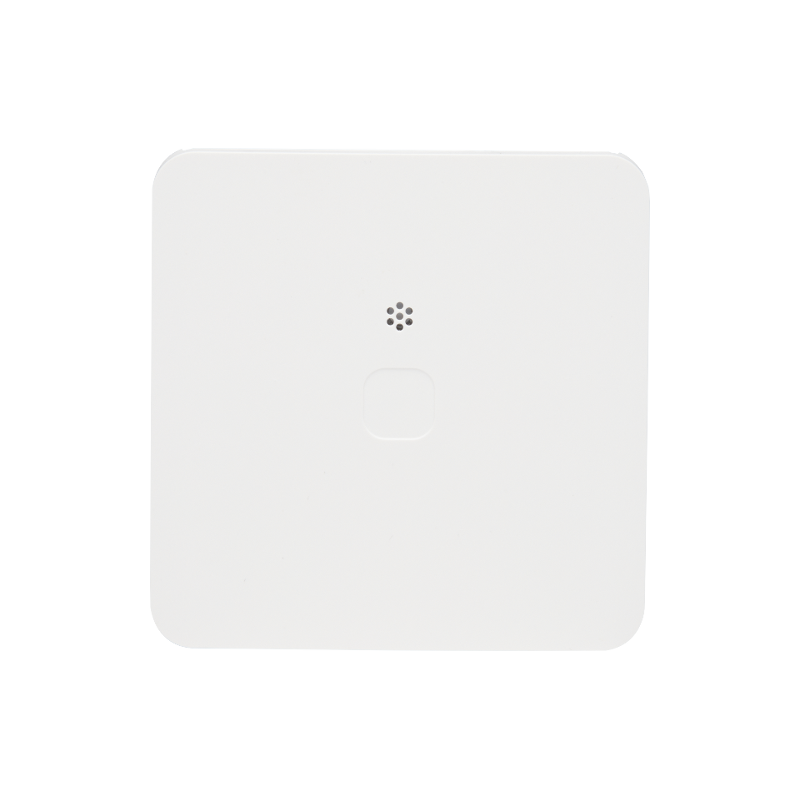
The Water Tile's optional accessory kits. Out of the box, the tile senses water at its own contacts, which means it protects the square it is sitting on. That is a real limitation, and it is the objection most people raise: the leak will not necessarily start where you put the sensor. DSC sells two accessory kits that fix it.
The water sensing cable kit (PGPx986-ACC-Cable, DSC part PGP-WT-SC6 for the 6-foot version, also made in 12 feet) runs roughly $40 for the 6-foot kit through third-party dealers and includes a wall-mount bracket plus the cable. The bracket screws to the wall, the tile slides in and clicks, and the cable plugs into the bracket. The important part: the cable detects water anywhere along its entire length. Instead of one detection point you get a detection line. Run it around the base of an ice machine, along the bottom of a mechanical-room wall, or across the full width of a dish machine, and water touching any part of that run trips the sensor. You lay the cable on the floor and secure it with the supplied clips at roughly 40 cm spacing, and after a leak you dry it off and keep using it.
The water sensing probe kit (PGPx986-ACC-Probe, DSC part PGP-WT-PRB) uses the same wall bracket with a single external probe instead of a cable. Lay the probe on the floor and tape it down. This is the right pick when you want the sensor body up off the ground but only need to watch one specific spot, like a drip pan or a single floor drain. DSC says not to connect the external probe to the sensing cable, so pick one accessory per tile rather than chaining them.
PowerG Flood Detector (DSC PG9985), roughly $77. The distinguishing feature is a 6-foot wire water probe. The sensor body mounts up on a wall or a shelf while the probe reaches down and back into a spot a tile cannot occupy: behind a wall-hung water heater, under a dish machine bolted in place, into a drip pan. It runs on a single 3V CR123A for roughly eight years, uses the same PowerG radio, and reports alarm, alarm restore, tamper, tamper restore, and low battery. It works with the IQ Panel 2+ and IQ Panel 4.
Three sensors, one decision rule. Use a bare Water Tile where there is an obvious low point on open floor near a known source, which is cheapest and covers freeze too. Use a Water Tile plus the sensing cable kit where you cannot predict exactly where water will surface and want a line instead of a point, which is the strongest choice for the two or three highest-risk zones in most buildings. Use the PG9985 when you need to reach into a space the sensor body cannot go, on the occasions it is in stock. Most businesses end up with a mix, usually a few bare tiles plus a cable kit on the worst spots.
PowerG Wireless Temperature Sensor (DSC PG9905), roughly $74. Temperature is the other half of environmental monitoring. The PG9905 takes configurable high and low thresholds, so you set alert points for the asset rather than for a generic room. An optional external probe lets you measure inside a cooler, freezer, or refrigerated case while the sensor body and its radio stay outside the metal box, which is the difference between a sensor that works in a walk-in and one that reports the temperature of the hallway. It reads from -20°C to 50°C (-4°F to 122°F) at the sensor body, and the external probe is rated wider at -30°C to 70°C (-22°F to 158°F), which is what lets it sit inside a freezer. It runs about seven years on a 3V CR123A, has high vibration immunity, and works with the IQ Panel 2+, IQ Panel 4, IQ Panel 5, IQ 4/5 Hub, and IQ Pro with the PowerG radio.
Use the PG9905 where you need a measured temperature with your own thresholds and a history you can pull up later, like a walk-in or a server room. Use the Water Tile's built-in low-temperature alert where you only need to know that a space is heading toward a burst pipe. If a space already has an Alarm.com Smart Thermostat, that is a third temperature data point you already own, reporting into the same energy management tools that manage the space's heating and cooling.
That freeze distinction is worth highlighting, because people collapse it. A low-temperature alert gives you hours of warning before anything breaks. A flood sensor gives you the news afterward. They are different alerts solving different problems, and in an unheated space over a holiday weekend the first one is the one that saves you.
One plan note before the placement guide. Flood and water sensors enroll as security-system sensors and work on any Surety Business plan tier. Temperature and humidity monitoring is a Business Plus feature. Business Alarm is $22 per month self-monitored or $29 professionally monitored; Business Plus is $26 or $33. If all you want is leak alerts, Business Alarm covers it. If you want cooler temperatures and logging, you want Business Plus, and the difference is $4 a month. Either way, environmental sensors add no per-sensor monthly fee: you buy the device once and it reports on the plan you already have.
Where to Put Them: A Room-by-Room Placement Guide
This is the part worth walking your building with. The goal is not maximum coverage, it is covering the places that combine a water source with low foot traffic, because those are the ones that run for forty hours instead of twenty minutes.
Under and behind the dish machine, ice machine, and coffee equipment. Supply lines, drain connections, and float valves, all inside a cabinet flush against a wall. This is the best case in the building for a Water Tile with the sensing cable kit: run the cable around the base of the machine so any escape point trips it, rather than betting on which corner the water reaches first. A bare tile at the low point behind the unit is the simpler version, and a PG9985 probe run under the cabinet works when the machine is fixed in place.
Water heater and boiler. Tanks fail at the bottom and fail all at once, so this is one of the few spots where the failure mode is genuinely sudden. Put a Water Tile in the drip pan or directly on the floor at the tank base. If the heater is wall-hung or wedged in a tight closet, use the tile's wall bracket with a probe or cable, or a PG9985 probe, to reach where a tile cannot sit flat.
HVAC air handler and condensate drain. As noted earlier, a clogged drain line puts pan overflow directly onto whatever sits below the air handler. A Water Tile in the secondary pan catches it before it reaches the ceiling tile. If the unit sits in an unconditioned space, pair it with a PG9905.
Mechanical room, utility closet, and wherever the main enters. The biggest failures start here and the least foot traffic happens here, which is the worst possible combination. This is where PowerG range earns its keep, because these rooms are concrete and far from the panel. A sensing cable run along the base of the wall covers the room's entire low edge instead of one tile guessing at where the floor actually drains, which in an older building is rarely where you would think. Bracket the tile on the wall and lay the cable.
Walk-in cooler and freezer. Two failure modes here: water on the floor from a defrost drain or a door left ajar, and temperature drift that quietly ruins inventory. A PG9905 with the external probe inside the box and the sensor body outside handles the second. Use one sensor per box so the cooler and the freezer each get their own thresholds. The urgency comes from the food safety side: the FDA's guidance on refrigerator temperatures and food safety says a refrigerator should be kept at 40 °F or below and a freezer at 0 °F, that bacteria causing foodborne illness can double every 20 minutes at room temperature, and that perishable food should never sit at room temperature for more than two hours, or one hour if it is above 90 °F. A two-hour window is why an alert at 2 a.m. is worth so much more than a log sheet checked at 9 a.m.
Server closet, IT room, and anywhere with a rack. Water and electronics, usually in a room that shares a wall with a restroom or sits under an occupied floor. Water Tile at the room's low point. Temperature belongs here too, because a mini-split that fails in a closed closet will cook a rack over a weekend without anyone noticing.
Restrooms, especially the ones above your sales floor. Toilet and sink supply lines, and floor drains that back up. A Water Tile behind the toilet and another under the sink is cheap coverage for a failure that lands on your merchandise.
Stockrooms and back rooms where inventory sits on the floor. The damage here is not the water, it is what the water is sitting in. Placement is less about finding the source and more about protecting the value, so put sensors where the inventory is lowest and most expensive.
Vacant units, seasonal spaces, and anything unheated. This is the freeze case, and it is the one that costs the most when it goes wrong. A Water Tile covers it with its low-temperature alert, or a PG9905 if you want thresholds tuned to the space. For property managers with units sitting empty between tenants, this is the highest-return sensor in the portfolio.
Sprinkler risers and standpipe connections. A leaking riser is a real and expensive event, and a floor sensor near the riser is useful. The limit matters though: do not install flow monitoring equipment on a fire suppression system, and coordinate anything that touches the sprinkler system with your fire protection contractor and the authority having jurisdiction. Watching the floor near it is a DIY job. Instrumenting the system itself is not.
| Location | What Fails There | Recommended Sensor | Placement Note |
|---|---|---|---|
| Ice machine, dish machine, coffee equipment | Supply lines, drains, float valves | Water Tile + sensing cable | Run cable around the equipment base |
| Water heater or boiler | Tank corrosion, sudden failure | Water Tile, or PG9985 probe | In the drip pan or at the tank base |
| HVAC air handler | Clogged condensate drain, pan overflow | Water Tile (+ PG9905 if unconditioned) | In the secondary drain pan |
| Mechanical room / water main | Burst pipes, fittings, valve failures | Water Tile + sensing cable | Cable along the base of the wall |
| Walk-in cooler and freezer | Defrost drain, door ajar, temp drift | PG9905 with external probe | Probe inside the box, body outside |
| Server closet or IT room | Leaks from above, HVAC failure | Water Tile (+ temperature) | Room's low point, near the rack base |
| Restrooms above the sales floor | Toilet and sink supply lines | Water Tile | Behind the toilet, under the sink |
| Stockroom and back rooms | Any of the above, plus roof leaks | Water Tile | Where inventory sits lowest |
| Vacant or unheated spaces | Frozen and burst pipes | Water Tile (freeze alert) or PG9905 | Near exterior walls and exposed pipe |
| Sprinkler riser area | Riser and connection leaks | Water Tile on the floor nearby | Never instrument the system itself |
Here is how the four products compare when you are deciding what to actually order.
| PowerG+ Water Tile (PGP9986) | Water Tile + sensing cable kit | PowerG Flood Detector (PG9985) | PowerG Temp Sensor (PG9905) | |
|---|---|---|---|---|
| Detects | Water and low temperature | Water and low temperature | Water | Temperature only |
| Detection area | Single point at the tile | A line along the full cable (6 or 12 ft) | Tip of a 6-foot probe | Ambient, or inside a box via probe |
| Form factor | Flat tile on the floor | Tile in a wall bracket, cable on floor | Wall or shelf mount, probe on floor | Wall mount, optional external probe |
| Freeze alert | Yes | Yes | No | Yes, with custom thresholds |
| Audible local alert | Yes | Yes | No | No |
| Battery | 2x CR2450, about 5 years | 2x CR2450, about 5 years | CR123A, about 8 years | CR123A, about 7 years |
| Wireless range | 2,000 to 2,500 ft open air | 2,000 to 2,500 ft open air | 2,000 to 2,500 ft open air | 2,000 to 2,500 ft open air |
| Approximate price | About $79 | About $79 + $40 for the 6-ft kit | About $77 | About $74 |
| Surety availability | In stock | Tile in stock, kit not currently | Not currently in stock | On backorder |
| Best for | Most locations, most budgets | Highest-risk zones, unpredictable water paths | Reaching into tight spaces | Coolers, freezers, server rooms |
Industry Playbooks
Restaurants and food service carry the highest concentration of risk per square foot: an ice machine, a dish machine, a walk-in cooler, a walk-in freezer, floor drains, and a water heater working hard, all in a space that sits empty eight to twelve hours a day. The starting kit is a cable-equipped tile at the ice machine, tiles at the dish machine and water heater, and PG9905 sensors with probes in the cooler and the freezer. The temperature side pays for itself separately in inventory alone. See the Surety Business restaurant and food service page for how this fits with the rest of a restaurant system.
Retail has a different shape. The water sources are fewer, but what sits underneath them is inventory and a sales floor. The priorities are the stockroom, any restroom on a floor above the selling space, the HVAC condensate pan over the sales floor, and the sprinkler riser area. See the retail page.
Property management is where this scales into real money, because the exposure is freeze damage in vacant units multiplied by the number of units. A unit sitting empty through a January cold snap with the heat turned down is the textbook burst-pipe scenario, and it is invisible until a tenant below calls. Water Tiles for their freeze alerts in vacant units, plus coverage in shared laundry rooms and mechanical rooms, is a small per-unit cost against a loss that does not stop at the unit it started in. See the property management page.
Professional offices concentrate risk in two rooms: the server closet and the breakroom. Add restrooms and the HVAC unit and you have covered most of it with four or five sensors. See the professional offices page.
Dental and medical offices add a compliance dimension. Sterilization and compressor rooms are water-heavy, and refrigerated medication storage carries documentation requirements that a temperature log in the platform answers directly. See the dental and medical page.
From Alert to Automatic: Water Shutoff with the Zooz Titan
An alert is not a response. If nobody can get to the building at 2 a.m., a flood sensor has upgraded a Monday-morning surprise to a Saturday-night one. That is a genuine improvement, and for many businesses it is enough. But if you want the leak to actually stop while you are still asleep, you need a valve.
Alarm.com supports several ways to do this, and we will cover all of them below. For most small businesses the answer is the Zooz Titan Water Valve Actuator, specifically the ZAC36 LR version, for two reasons that are hard to argue with: it is the least expensive option, and it is the only one you can install yourself without touching a pipe. It is available from Zooz online rather than through the Surety store, at a street price around $170 (list $199.95). It is an Alarm.com-compatible Z-Wave device that you buy from Zooz, enroll on your panel, and run alongside everything else, with Surety supporting the integration.
The reason it works for small businesses is that it is a retrofit, not plumbing. Per Zooz's product documentation for the Titan, it clamps onto an existing quarter-turn ball valve and physically turns the handle. No cutting pipe, no plumber, no permit, and a tool-free install in under five minutes.
The constraint you need to check before you order anything: it fits ball valves only, 1/2 inch to 1-1/4 inch. If your building's main shutoff is a gate valve, the round multi-turn handle common in older buildings, the Titan will not fit and you will need a plumber to swap in a ball valve first. This is the most common reason a shutoff project stalls, so go look at your valve before you buy. You also need clearance: roughly 3 inches on each side of the valve center, 1 inch between pipe and wall, and 1.25 inches between the valve handle and the pipe.
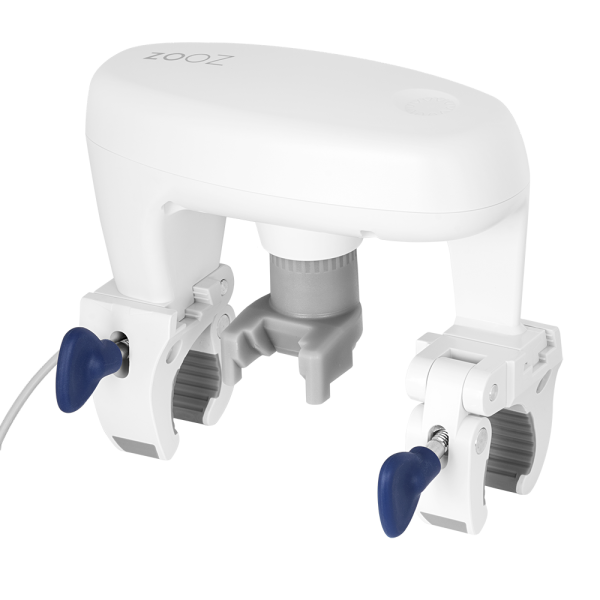
On the radio side, the Titan uses a Z-Wave 700 series chip with S2 Authenticated security and SmartStart pairing. Z-Wave Long Range support is on the LR variant, and that is the one to buy, because Long Range covers far more distance than a standard Z-Wave mesh manages indoors. Since the valve is almost always in a back mechanical room and the panel almost always is not, that reach is usually what decides whether the valve responds reliably. Long Range depends on your panel and firmware as well as the device, so confirm it with Surety for your specific setup, and expect to add repeaters if you end up running a non-LR unit far from the panel.
The motor puts out 6 N·m of torque and auto-calibrates to fully open and fully closed. It also runs a periodic self-test, a small 1/8 turn rather than a full open-close cycle, which keeps a valve that has not moved in two years from seizing in place. That detail matters more than it sounds: a shutoff valve you have never exercised is a valve you should not count on. There is a built-in temperature sensor reading -40°F to 257°F for freeze warning at the valve itself, and the unit is IP66 rated for indoor or outdoor mounting. It runs on an included 12V DC 1A supply with a 9.5-foot cord, with an optional backup battery sold separately. On a power loss the valve holds its last position and resumes normal operation when power returns.
The feature worth paying for on its own is the 4.75-foot wired leak probe. Water on that probe closes the valve locally, with no hub, no panel, and no cloud involved. If your internet is out, your panel is down, or the Z-Wave link drops, that probe still shuts the water off. Local fail-safe behavior is rare in this category and it is the reason the Titan is worth recommending over alternatives.
Automating the shutoff from your flood sensors takes an Alarm.com rule, and there are two things about that rule worth knowing before you buy hardware, both documented publicly by Surety support on the Surety support forum.
First, Z-Wave leak sensors cannot trigger a water valve rule on Alarm.com. The trigger has to be a PowerG or 319.5 MHz RF flood sensor enrolled as a security-system sensor. This is the practical reason to buy the PowerG sensors described above rather than a cheaper Z-Wave leak puck: the PowerG sensor is what makes automatic shutoff possible at all.
Second, building the rule got noticeably easier this year. In February 2026 Alarm.com added water valve control to the "Any Water Sensor" alarm rule trigger, so one rule now closes the valve when any flood sensor in the building reports water. Before that update you had to build a separate rule naming each sensor individually, which was workable but tedious once you had more than two or three. Manual open and close is always available from a dedicated valve card in the Alarm.com app.
The other shutoff options, and when they make more sense. The Titan is the value pick, not the only pick, and three alternatives are worth knowing about because each buys you something the Titan does not.
The Alarm.com Smart Water Valve (ADC-SWV100) is an inline valve rather than a clamp-on actuator. It is a 1 inch brass valve with female NPT threads that gets plumbed into the water line, which means fittings sized to your existing pipe and, in most commercial buildings, a plumber and attention to local plumbing code. It runs on 100-240 VAC with a long power lead, uses Z-Wave Plus with S2 security, is indoor-only, rated 14°F to 185°F, and conforms to NSF/ANSI 61 and 372 for potable water. You are paying more, and paying for labor, to get a purpose-built valve rather than a motor strapped to the one you already have. That is the right trade when your existing shutoff is old, awkward to reach, or a gate valve that would need replacing anyway.
The Alarm.com Smart Water Valve+Meter (ADC-SWM150) is the same inline approach with metering added. It is a 1 inch valve for pipe up to 1-1/4 inch, and beyond shutting off the water it measures flow, which lets it catch leaks by their usage signature rather than waiting for water to reach a sensor on the floor. That covers the gap point sensors cannot: a slow leak inside a wall, a running fixture, a drip that never puts water anywhere you thought to look. If you want both shutoff and whole-property leak detection in one device, this is the Alarm.com-native way to get it.
Flo by Moen integrates with Alarm.com as a cloud-to-cloud connection rather than a device on your panel. You install the Flo (professionally, per Moen, since it goes inline on the main), get it on Wi-Fi, then link your Flo account to Alarm.com from the app or website. Once connected you can shut the water off from the Alarm.com app, build automation rules, and receive leak alerts alongside everything else, and the Flo brings its own continuous flow monitoring and leak analysis. Like the Water Dragon, it needs both the Water Management and Water Management Plus service add-ons on the account, so budget for that alongside the hardware. Surety support has published a walkthrough of the Flo by Moen integration if you already own one or are weighing it.
| Zooz Titan (ZAC36 LR) | ADC-SWV100 | ADC-SWM150 | Flo by Moen | |
|---|---|---|---|---|
| How it installs | Clamps on your existing ball valve | Plumbed inline | Plumbed inline | Plumbed inline |
| Plumber needed | No | Usually | Usually | Yes, per Moen |
| Cuts into the pipe | No | Yes | Yes | Yes |
| Relative cost | Lowest (about $170) | Higher, plus labor | Highest, plus labor | Higher, plus labor |
| Monitors water flow | No | No | Yes | Yes |
| Works if internet is down | Yes, via its wired probe | No | No | No |
| Connects via | Z-Wave to your panel | Z-Wave to your panel | Z-Wave to your panel | Cloud-to-cloud, over Wi-Fi |
| Best for | Most small businesses | Replacing an aging or awkward shutoff | Shutoff plus whole-property leak detection | Businesses that already own one |
If your existing main shutoff is a serviceable ball valve in the right size, the Titan does the same job as the inline valves for less money and without a plumber, which is why it leads here. If you are already opening the pipe, or you want flow monitoring in the same device, the inline options earn their cost.
| Sensors only | Sensors + Titan valve | |
|---|---|---|
| What happens at 2 a.m. | Phone alerts fire, water keeps running | Water stops, then phone alerts fire |
| Response time | However long until someone arrives | Seconds |
| Who has to act | You, or whoever has keys | Nobody, initially |
| Added cost | $0 beyond the sensors | About $170, one time |
| Physical requirements | None | 1/2 to 1-1/4 inch ball valve with clearance |
| What can go wrong | Nobody can get there in time | Water off in a space that needed it |
What About Leaks You Cannot See?
Point sensors catch water where you put them, which means they will not catch a slow leak inside a wall, above a ceiling, or under a slab. That is a real gap and no amount of tile placement closes it.
The platform-level answer is the Alarm.com Water Dragon (ADC-SHM-100-A). It clips onto the incoming water main with a clip-and-zip install (no plumber, no cut pipe) and watches flow downstream, catching hidden leaks, running fixtures, and unexpected usage, while also monitoring pipe temperature for freeze risk and charting usage trends in the app. Alarm.com's CES 2023 announcement describes it as using ultrasonic sensing, and it runs on Z-Wave Long Range so it reports from a utility room without repeaters. It is a monitor, not a valve: it detects and alerts but does not shut off water, so it gets paired with something like the Titan for automatic response.
Several caveats before you plan around it. It fits 3/4 inch or 1 inch rigid copper (Type M or L), CPVC, or PEX only, so many commercial services are either too large or the wrong material. It must not be installed on a fire suppression system line. It is AC powered, so it needs an outlet near the main. It requires both the Water Management and Water Management Plus service package add-ons on the account, which is two add-ons, not one. And availability is limited: the Water Dragon has had a restricted release through Alarm.com and is not a standard stocked item at Surety, so treat it as a capability to ask about rather than something to add to a cart. Our article on Z-Wave Long Range for business covers the Water Dragon and Titan pairing in more depth.
If flow monitoring is what you actually want and the Water Dragon does not fit your pipe or your timeline, the two inline options from the valve section cover the same ground in a single device: the ADC-SWM150 meters flow and shuts the water off, and a Flo by Moen does the same through the Alarm.com integration. Both cost more and both mean opening the pipe, but neither is waiting on a restricted release.
Why Running It on Alarm.com Changes the Math
A standalone leak detector tells one person one thing. A sensor on Alarm.com for Business is part of a system, and that is most of the value.
Alerts go out over push notification, email, and text, configured per user, so a 2 a.m. flood alert reaches the owner, the general manager, and whoever lives closest, not just whoever happens to have the app open.
On a professionally monitored plan, a water alarm does not just push a notification: the central station calls you. That matters at 2 a.m., when a phone buzzing on a nightstand gets slept through and a ringing phone does not. It is the difference between an alert that technically fired and an alert that actually woke somebody up, and on a leak that is running under line pressure, those are not the same event. Professional monitoring is a $7 per month step up on either Surety Business plan.
Because the sensor is a system device, it can trigger automation rules and scenes that you configure. A leak can close the valve, log the event, pull a camera clip, and notify a list, all from one rule you set up once. Nothing here is the system deciding on its own; these are rules an owner writes and can change.
It is also one app and one bill. The same place you arm the system, check the cameras, and manage door codes is where the flood sensor lives. That preference is close to universal: in the Alarm.com survey cited in that CES announcement, 88% of 1,200 respondents wanted a single app controlling security, water protection, and energy management, and 83% believed an automated detection system would prevent or lessen water damage. That survey covered homeowners rather than businesses, but the operational logic is stronger for a business, not weaker, because a business has more systems and more people who need to see them.
Temperature history is stored in the platform, which turns monitoring into documentation. When a health inspector asks what the walk-in was doing on a specific night, or an adjuster wants to know how long a cooler was out, you have the record. That is a Business Plus feature, and it is worth the $4 difference for anyone storing food or medication.
For anyone running more than one location, the multi-site dashboard shows environmental status across every site at once, which is the difference between managing eight buildings and checking eight apps. And because every sensor event lands on the same timeline as door openings and camera clips, reconstructing what actually happened at 2 a.m. is one screen rather than three systems.
What It Costs and What It Saves
The arithmetic here is unusually favorable, which is why it is worth doing explicitly. The honest way to frame a risk-mitigation purchase is not a rate of return but a fraction of one loss.
Break-Even = Total Sensor Cost ÷ Average Claim Cost
Work it for a restaurant, using the same kit described in the playbook above. Three Water Tiles at about $79, a sensing cable kit at about $40 for the ice machine, and two PG9905 sensors at about $74 for the walk-in cooler and freezer comes to roughly $425 in hardware, plus the external probes for the two boxes. That is one time, with no per-sensor monthly fee on top of the plan you already carry. Against The Hartford's $34,600 average water and freezing damage claim, that deployment runs a little over 1% of a single claim. Add the Titan valve and you are near $600, still under 2%. Set that against a category that accounts for one in five small-business claims, and it is about as lopsided as risk spending gets.
This is a risk-reduction calculation, not a guaranteed return, and the sensors do not lower the cost of a leak you would have caught anyway. What you are buying is the delta between a twenty-minute leak and a forty-hour one, and without the valve you are buying notification rather than intervention.
Deductibles are part of the math too, and people forget them. Many small-business policies carry deductibles somewhere in the $1,000 to $2,500 range (check yours, they vary widely). A leak caught early enough to handle without filing anything keeps the deductible in your pocket and, more importantly, keeps the claim off the loss history that drives your next renewal. Avoiding the claim is usually worth more than the claim payout would have been.
On insurance credits specifically: carriers and brokers increasingly ask about leak detection, and some offer credits or risk-mitigation consideration, but there is no reliable published figure for a commercial leak-detection discount, so ask your own agent what your carrier does. The direction of the industry is clear enough. The Hartford's claim data is why, and on the residential side Mercury Insurance's water leak detection program has gone as far as covering $400 of installation cost for a smart shutoff plus a 10% discount on a portion of the policy. That is a California homeowners program rather than a commercial one, so it is not something you can claim, but it shows where carriers are pointing.
The rest of the picture is straightforward. Batteries last five to eight years. There is no wiring and no plumber for the sensors. You self-install, and you scale one sensor at a time as budget allows. Compared with a traditional commercial provider, you get the same professional Alarm.com platform with transparent pricing, month to month, and you own your equipment.
What These Sensors Will Not Do
Every one of these is a real limit, and knowing them up front is the difference between a system that protects you and one you think protects you.
A sensor only sees the spot it is in. Water finds the low point, and the low point is not always where you guessed. That is the honest reason to reach for the sensing cable in your highest-risk zones, because a line beats a point when you cannot predict where water will surface. Even then, no floor sensor catches a leak inside a wall, above a ceiling, or under a slab.
An alert is not a response. If nobody can reach the building and there is no automatic shutoff, you have moved the discovery earlier without stopping the water. Better, but only if someone acts on it.
The Titan has hard physical constraints. Ball valves only, 1/2 inch to 1-1/4 inch, with clearance. Gate valves and larger commercial services need a plumber first, and at that point one of the inline valves may be the better buy anyway.
Shutting off the water has consequences. In a restaurant mid-service, or in a building where a fire suppression system is fed from the same service, an automatic close is not automatically the right call. Think about what else that valve feeds, and consider notify-only rules for some zones and automatic shutoff for others.
Temperature and humidity monitoring requires Business Plus. Flood sensors work on any tier.
Watch the temperature rating in the coldest spaces. The Water Tile is rated down to 14°F, and UL evaluated it over a narrower 32°F to 120°F band. In a genuinely unheated space during the cold snap you bought it for, the device itself can end up operating outside spec. It is still the right call in most stockrooms and vacant units, which rarely get that cold indoors, but in an uninsulated outbuilding or a space that regularly drops below freezing, put a PG9905 with its wider-rated probe on the job instead.
Batteries die eventually. Multi-year is not forever. The panel reports low battery, so pay attention to those notifications, because a sensor with a dead battery is worse than no sensor: it is a place you have stopped worrying about.
Test it. A flood sensor that was never tested after installation is an assumption, not a safeguard. Do a wet test on each sensor at install and once a year after that, and exercise the valve if the Titan's self-test is not enabled.
The Water Dragon is limited on both availability and pipe compatibility. Ask before you plan around it.
How to Get Started with Surety Business
Environmental monitoring adds onto any Surety Business plan. If you already have a Qolsys IQ panel, the sensors enroll to it directly, and if you are starting fresh, the sensors come along with the rest of the system. Flood sensors work on any tier; add Business Plus if you want cooler and server-room temperature monitoring with history.
Installation is a self-install job: set the tile, enroll it from the panel, test it with a wet finger, and configure who gets notified. There is no wiring and no plumber, which is the whole reason a two-person business can protect a building the way a chain does. If you would rather talk through placement before ordering, that is what Surety's support team and forum are for.
Start with the two or three worst spots in your building rather than trying to cover everything at once. For most businesses that is the ice machine or dish machine, the water heater, and the mechanical room. Add from there as budget allows. The water and environmental sensors page has the current lineup, and plans and pricing shows what each tier includes.
Water damage is one of the most frequent and most expensive things that can happen to a small business, and it is also one of the most preventable, which is a rare combination. The failure is almost never the leak itself. It is the forty hours nobody knew.
Frequently Asked Questions
- How much does water damage cost a small business?
The Hartford's analysis of more than one million small-business policies found the average water and freezing damage claim runs about $34,600, and that water and freezing damage is tied for the most common small-business claim at 20%. That average covers repair and replacement only. It does not include business interruption, lost inventory, or the customers you lose while you are closed, which for a restaurant or retail store is often the larger number.
- Where should I put water sensors in a commercial building?
Start with the places that combine a water source with low foot traffic: under and behind ice and dish machines, at the base of the water heater, in the HVAC condensate pan, in the mechanical room where the main enters, in the server closet, and behind restroom fixtures. Add freeze or temperature coverage in walk-in coolers, unheated stockrooms, and vacant units. The placement guide above has the full room-by-room walk-through.
- Can a water sensor automatically shut off my water?
Not by itself. A flood sensor detects and alerts. To shut off automatically you add a valve actuator like the Zooz Titan, which clamps onto an existing quarter-turn ball valve and closes it on an Alarm.com rule. The trigger has to be a PowerG or 319.5 MHz flood sensor, because Z-Wave leak sensors cannot trigger a valve rule on Alarm.com. As of February 2026 you can build a single rule using the "Any Water Sensor" trigger, so one rule covers every flood sensor in the building. The Titan also has a wired leak probe that closes the valve locally even if the panel or internet is down.
- Do I need a plumber to install a water leak detection system?
Not for the sensors. PowerG flood and temperature sensors are wireless, battery powered, and set in place in minutes. The Zooz Titan valve actuator is also a retrofit that clamps onto an existing ball valve without cutting pipe. You would need a plumber only if your building's main shutoff is a gate valve rather than a 1/2 inch to 1-1/4 inch ball valve, in which case the valve has to be swapped before the actuator will fit.
- Does adding water sensors cost extra per month?
No. Environmental sensors report on your existing Surety Business plan with no per-sensor monthly fee. Flood sensors work on any plan tier. Temperature and humidity monitoring is included with Business Plus, which is $26 per month self-monitored or $33 per month with professional monitoring. See Surety Business plans for current pricing.
- Will water leak sensors lower my business insurance premium?
Sometimes, and the direction of the industry is clearly toward rewarding them. Carriers and brokers increasingly ask about leak detection, and some offer credits. Mercury Insurance, for example, launched a program back in 2021 that covered $400 toward a Flo by Moen smart shutoff with professional installation, plus a 10% discount on a portion of the homeowners policy. That is a California homeowners program rather than a commercial one, and it is several years old, but it shows the direction carriers have been moving. Ask your own agent what your carrier offers. The more reliable savings is avoiding the claim and the loss history in the first place.
- Can a water sensor cover a whole area instead of one spot?
Yes, with a sensing cable. The PowerG+ Water Tile has an optional accessory kit (available in 6-foot and 12-foot cable lengths) that puts the tile in a wall bracket and runs a sensing cable along the floor. The cable detects water anywhere along its entire length, so you can run it around an ice machine, under a dish machine, or along a mechanical-room wall and get a detection line instead of a single point. Surety stocks the Water Tile but not the cable and probe accessory kits at the moment, so ask about current availability.
- What is the difference between a flood sensor and a freeze sensor?
A flood sensor tells you water is already on the floor. A freeze or low-temperature sensor tells you the space is heading toward the temperature where a pipe bursts, which gives you hours of warning instead of a cleanup. You want both, and the PowerG+ Water Tile does both in one device, which is why it is the easiest default for most small businesses.
- Can I monitor my walk-in cooler temperature for food safety?
Yes. The PowerG PG9905 temperature sensor supports an optional external probe so the probe sits inside the cooler while the radio stays outside the metal box, and you set your own high and low alert thresholds. Alarm.com keeps the temperature history, which is useful documentation for inspections. Use one sensor per box, so a walk-in cooler and a walk-in freezer each get their own. Temperature and humidity monitoring is included with the Business Plus plan.
